
Bidding for Public Sector Contracts in Australia
A Guide to Quadruple Bottom Line Compliance
To successfully secure public sector contracts across Australian federal, state and territory jurisdictions, businesses must demonstrate a commitment to the Quadruple Bottom Line — evaluating performance across economic, environmental, social and governance (OH&S) outcomes. This guide is your plain-English roadmap.
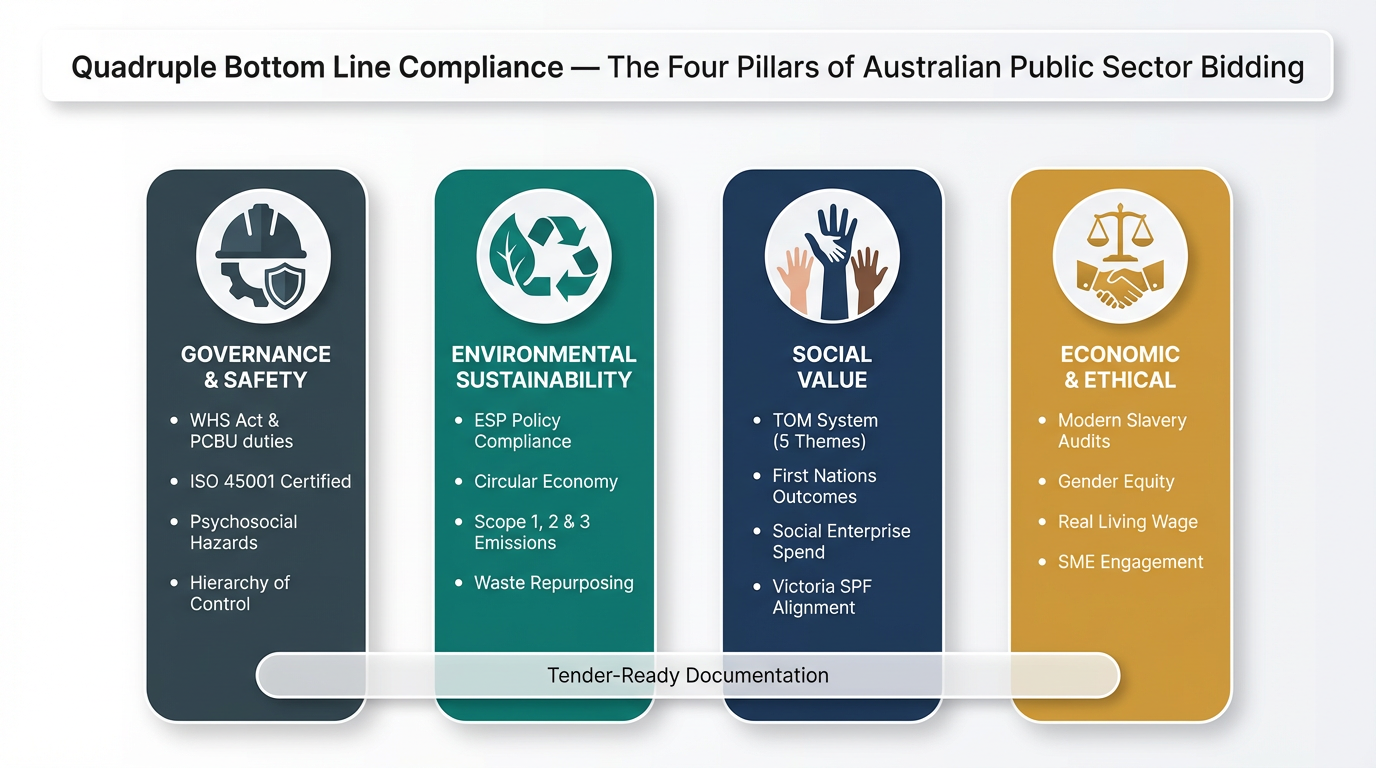
The four pillars of Quadruple Bottom Line compliance for Australian public sector procurement.
Government procurement across Australia is increasingly leveraging purchasing power to drive circular markets, social equity, and robust safety standards. Successful bidders must move beyond "business as usual" to provide documented evidence of their impact across these four pillars.
Pillar 1
Foundational Governance and Safety Requirements
Workplace Health and Safety (WHS) is a critical component of the governance pillar. In Australia, the legal framework is established by the Work Health and Safety (WHS) Act, which identifies the Person Conducting a Business or Undertaking (PCBU) as the primary duty holder.
Universal foundational documents
- WHS Policy: A formal statement signed by top management committing to the prevention of injury and illness, legal compliance, and continuous improvement.
- Risk Register: A central document used to systematically identify, assess, and categorise hazards (High, Medium, Low) using a risk matrix.
- Safe Work Method Statements (SWMS): Mandatory for high-risk construction work; these documents break down tasks into steps, identify hazards, and spell out specific controls.
- Emergency Plan: Rehearsed procedures covering evacuations, medical events, and communication methods.
- Corrective Action Plan: A roadmap for improvement resulting from internal audits, detailing responsibilities and deadlines.
The strategic asset: ISO 45001 certification
While following the WHS Act is a legal minimum, achieving ISO 45001 certification is often a prerequisite for major government and corporate tenders. This international standard demonstrates a systematic, proactive approach to safety.
- Officer Due Diligence. Senior leaders must be proactive in ensuring the business meets WHS obligations to avoid personal liability.
- Psychosocial Hazard Management. Modern compliance requires addressing psychological harm — burnout, bullying and extreme job demands. Mental health conditions now account for 12% of serious workers’ compensation claims in Australia.
- Hierarchy of Control. Documentation must prove the business prioritises Elimination of hazards over lower-level controls like PPE.
Pillar 2
Environmental Sustainability and the Circular Economy
The Australian Government’s Environmentally Sustainable Procurement (ESP) Policy aims to minimise environmental impact by prioritising recycled materials and waste reduction.
Key deadlines and thresholds
| Effective Date | Industry Sector | Contract Value Threshold |
|---|---|---|
| 1 July 2024 | Construction Services | Above $7.5 million |
| 1 July 2025 | Textiles, ICT Goods, Furniture & Fittings | Above $1 million |
Required environmental outcomes
- Waste Repurposing: Strategies to cut waste and replace single-use materials with recycled content.
- Circular Economy Solutions: Demonstrating how materials stay in the economy longer (e.g. recovering worn-out uniforms to process into new textiles).
- Emissions Disclosure: Commitments to measure and disclose Scope 1, 2 and selected Scope 3 emissions.
Pillar 4
Economic Pillar and Responsible Business Practices
The economic pillar focuses on building diverse supply chains and promoting fair work.
Essential internal policies and certificates
- Social Procurement Strategy: Required for TAFE and major Victorian projects to outline how the business will meet social objectives.
- Modern Slavery Audit / Statement: Documentation of supply chain audits to identify and manage the risk of modern slavery.
- Gender Equity Programs: Evidence of initiatives to promote gender equity and the proportion of leadership positions filled by women.
- Real Living Wage Documentation: Ensuring contractors within the supply chain pay employees a real living wage.
- Social Enterprise Certification: Partnering with or being certified by organisations like Social Traders (Australia’s leading body for social enterprise).
Summary
Universal Compliance Documentation
To remain competitive, businesses should maintain a "tender-ready" library including:
| Category | Essential Documentation |
|---|---|
| Safety | ISO 45001 Certificate, WHS Policy, Risk Register, SWMS, Incident History / Reports. |
| Environmental | ESP Policy Compliance Plan, Emissions Disclosure Report, Circular Economy / Recycling Policy. |
| Social | Social Procurement Plan, Aboriginal & Torres Strait Islander Engagement Plan, Volunteer / Donation Logs. |
| Economic | SME / Social Enterprise Spend Reports, Supply Chain Modern Slavery Audits, Gender Pay Equity Policy. |
| Governance | Family Violence Leave Policy, Good and Fair Work Charter Implementation, Board-signed WHS Due Diligence reports. |
Note on remote delivery
The TOM System for Australia includes specific Remote Measures. Businesses delivering services in remote or isolated areas can claim higher proxy values, as these initiatives often have a significantly greater impact on local community resilience.
Ready to build your tender-ready evidence library?
Whether you’re a buyer setting the requirements or a bidder preparing a response, Clause & Effect and TenderReady give you the structured workflows to meet every pillar of Quadruple Bottom Line compliance.
Pillar 3
Social Procurement Frameworks
Social value is now a core expectation, particularly under state-specific frameworks like Victoria’s Social Procurement Framework (SPF), which applies to all departments, agencies and TAFEs.
Documenting social value via the TOM System
The TOM System (Themes, Outcomes, Measures) is the recognised framework for measuring and reporting social value in Australia. It allows businesses to quantify their impact in financial terms using proxy values.
The five themes of the Australian TOM System:
Thresholds for Victorian Government projects